El pretérito perfecto compuesto1
Meaning. ‘Pretérito perfecto compuesto’ in Spanish2 describes an event (either one-time or durative) that started in an unspecific point in the past and, either the event itself or its results, extend until the moment of speech. Thus, the event is watched and assessed from the present. It is called ‘pretérito’ because it is a passed action; ‘compuesto’ because it is made up of two parts, and ‘perfecto’ because the action is peceived as completed at the moment of speaking.
Ejemplo:
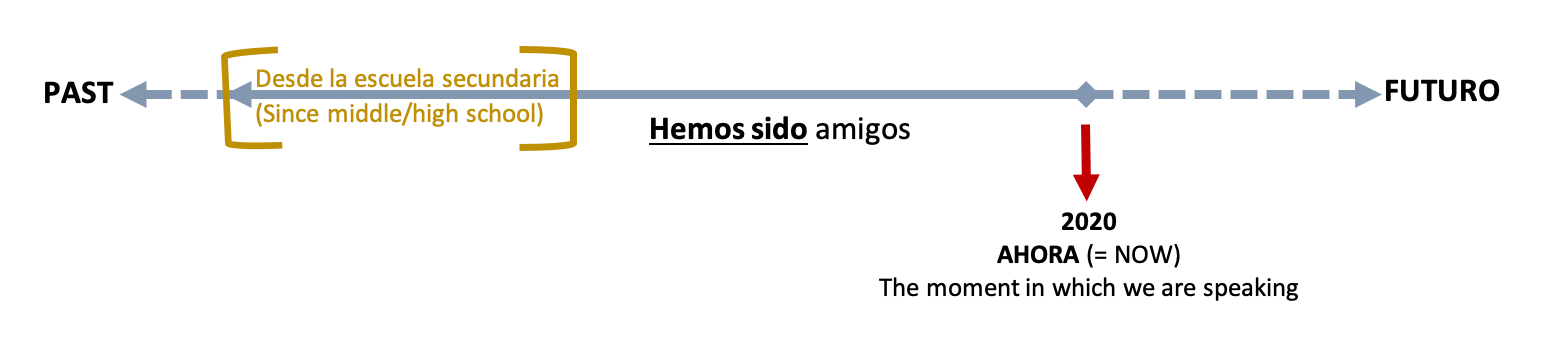
Hemos sido amigos desde la escuela secundaria.
We have been friends since middle/high school.
Event/Action/State: ser amigos
When it started: en la escuela secundaria (caso personal: 1986-1990)
Implications: we are still friends
How long: between 30 and 34 years.
Recent Events. In occasions, the PPC describes events that just happened: El paquete ha llegado esta mañana (=The package has arrived this morning). When no temporal expression is used, we assume the event has happened no longer than the day when we are speaking. This use can be seen in newspapers and mass media, which allows for the news to be related to the moment of speech: El presidente Alberto Fernández ha twiteado un saludo de año nuevo a todos los argentinos.
Expressing Results. Usually, the use of PPC allows the listener to infer a result: La separación me ha deprimido (The break up has depressed me) implies I am depressed now. In general, the results are visible or obvious.
Dialectical Variations in Meaning. In some geographic areas (Bolivia, Norwest and Central regions of Argentina, areas of Cuba and the Antilles, and center and south of Spain), the ‘pretérito perfecto compuesto’ (ha muerto = he has died) is used as an equivalent of the ‘pretérito perfecto simple (PPS)’ (murió = he died). However, in many other regions (México, Venezuela, many of the Central American countries), there is a clear distinction between these two verbal tenses. The PPS is used for finished events in the past (Viví en España dos años = I lived in Spain two years) while the PPC describes events that are perceived as continuing into the present (Siempre he vivido aquí = I have always lived here). (RAE, 23.4.1b, p. 438).
1 Major references for this section are RAE’s Nueva gramática de la lengua española. Manual, pages 438-443 and 461-462 (2010). pages 1721-1736; Nueva gramática de la lengua española. Morfología y Sintaxis I, pages 1865-1960 (2010).
2 Textbooks in America usually call this verbal tense ‘Presente Perfecto’(=‘Present Perfect’), following the English terminology. We prefer to follow here the RAE’s nomenclature. While comparison with this English verbal tense is certaintainly useful for foreign students, the equivalence should never be taken as absolute. The meaning of verbal moods, tenses and aspects should always be analized in use, obviously in the context of the language we are studying (and never in our native language). For further analysis on the nomination of the past verbal tenses in Spanish, see El pasado en español. Estudio de los nombres de los tiempos del pasado en español by Luis Pérez Tobarra, Revista RedELE, 6.JUN.2006 https://www.educacionyfp.gob.es/educacion/mc/redele/revistaredele/numerosanteriores/2006/segunda.html