Writing Process Knowledge
You have to admit that you’ve probably pulled off some kind of big writing project for school or work at the last minute. It probably was not painless—you probably incurred much stress and lost a lot of sleep—but it got done. Maybe you even did well on it. Decades of research in composition studies shows, however, that developing an effective writing process not only takes the pressure off of some writing tasks—and helps preserve your sleep—but also results in a finished product of higher quality. The following passages, adapted from the eBook Methods of Discovery – Online Writing Guide, introduce the general stages of the writing process.
The word “process” itself implies completing tasks in stages and over time. Applied to writing, this means that as you proceed from the beginning of a writing project through its middle and toward the end, you go through certain definable stages, each of which needs to be completed in order for the whole project to succeed.
Composing is very complex intellectual work consisting of many complex mental activities and processes. It is often difficult to say when and where one stage of the writing process ends and the next one begins. However, it is generally agreed that the writing process has at least three discreet stages: invention, revision, and editing. In addition to inventing, revising, and editing, writers who follow the process approach also seek and receive feedback to their drafts from others. It is also important to understand that the writing process is recursive and non-linear. What this means is that a writer may finish initial invention, produce a draft, and then go back to generating more ideas, before revising the text he or she created.
Invention. This stage, in essence, is figuring out what to write about. Writers often engage in prewriting activities, which as the prefix “pre-” implies, would be completing some writing before writing the actual project in order to generate ideas. Read some examples of prewriting activities in the eBook Methods of Discovery – Online Writing Guide.
For example, you might do some focused freewriting, writing non-stop whatever comes to your mind about a particular topic for a duration of time. Or you might brainstorm and list ideas or draw them. Or you might even respond to a number of idea-generating questions related to the topic. Conducting research may be part of your invention on some writing projects (Chapter 4 discusses research). It is also a good idea to plan out what you want to write and in what order before drafting by creating a formal or a sketch outline.
Drafting. Drafting is actually sitting down to write a first draft of the writing project. You could use your outline as a guide, but be open to new ideas or new structures while you write—remember to use writing as a tool for learning and discovering ideas.
Revising. All skilled writers—even professionals—revise and then edit their work. Rarely is great work produced in a single sitting on the first try—that’s a myth. As a matter of fact, many experienced writers consider revising the most important part of writing. Try not to think of your first draft as deficient but rather in need of some revision to better fit the discourse community, genre, and rhetorical situation of the assignment. Revision means to re-see. Therefore, as a writer, take the time to re-see your draft from a reader’s point of view and make revisions to better convey your point to your readers and the other parameters of your rhetorical situation for the assignment. A number of revision strategies are available in the eBook Open English @ SLCC.
Editing. For each writing project you complete, you’ll want to revise for “global” concerns of focus, development, and organization, and then edit for “local” issues at the sentence-level. Some people call these larger-order concerns vs. smaller-order concerns. Why would you waste your time editing the commas in your opening, when actually that whole paragraph needs to be deleted? I think of this every time I cook broccoli. I chop the crown, the tree-like part of the stalk, into smaller pieces and then have to fit them all in the steamer basket. I first have to place the big (global, larger-order) pieces and then the little (local, smaller-order) pieces in order to get them all to fit. It’s the same thing with revising first and then editing after: first the big stuff and then the little stuff. Also, you may be able to draft certain writing projects in one sitting, but I highly recommend revising and then editing in multiple, shorter sessions.

You may have been taught the writing process in a rather linear way, exemplified in the graphic from Open English @ SLCC.
Yet, in her case study research showing differences between student and experienced writers, Nancy Sommers explains that experienced writers “see their revision process as a recursive process—a process with significant recurring activities” (386). The student writers she studied lacked that “sense of writing as discovery—a repeated process of beginning over again, starting out new” (387). She claims that students “need to seek the dissonance of discovery” (387). Many student writers it seems—and maybe you share this view—see the writing process as completing a series of steps in order (e.g. until you get a written product that meets the minimum length requirement), while experienced writers manipulate that process for their own purposes in order to discover ideas and strategies until they end up with a “good” finished product. Sommers claims, “Good writing disturbs; it creates dissonance” (387). (For some other research on writers’ processes see Perl, Berkenkotter, and Takayoshi.)
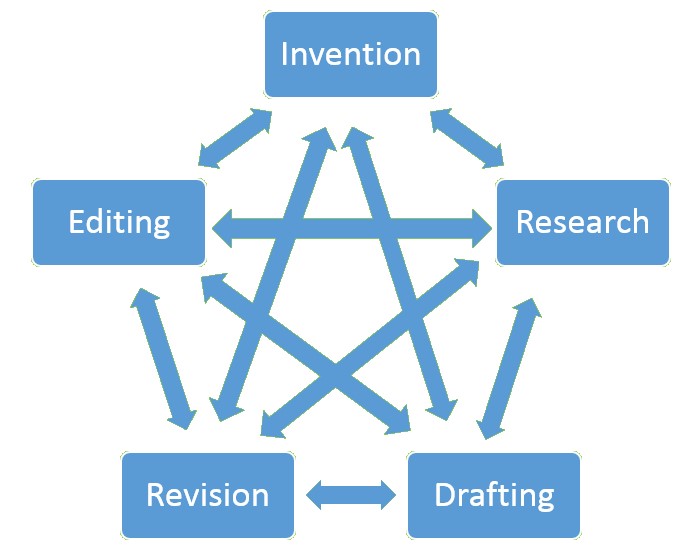
This graphic, however, demonstrates the writing process as it actually is for experienced writers, which is recursive.
The following passage from Open English @ SLCC provides an example of how this recursiveness of the writing process works:
For example, a colleague and I wrote a chapter for a book on working conditions at colleges, a topic we’re interested in.
- When we started, we had to come up with an idea for the text by talking through our experiences and deciding on a purpose for the text. [Invention]
- Although we both knew something about the topic already, we read articles and talked to experts to learn more about it. [Research]
- From that research, we decided that our original idea didn’t quite fit with the research that was out there already, so we made some changes to the big idea. [Invention]
- After that, we sat down and, over several sessions on different days, created a draft of our text. [Drafting]
- When we read through the text, we discovered that the order of the information didn’t make as much sense as we had first thought, so we moved around some paragraphs, making changes to those paragraphs to help the flow of the new order. [Revision]
- After that, we sent the rough draft to the editors of the book for feedback. When we got the chapter back, the editors commented that our topic didn’t quite fit the theme of the book, so, using that feedback, we changed the focus of the ideas. [Invention]
- Then we changed the text to reflect those new ideas. [Revision]
- We also got feedback from peer reviewers who pointed out that one part of the text was a little confusing, so we had to learn more about the ideas in that section. [Research]
- We changed the text to reflect that new understanding. [Revision and Editing]
- After the editors were satisfied with those revisions, we proofread the article and sent it off for final approval. [Editing]
In this process, we produced three distinct drafts, but each of those drafts represents several different ways that we made changes, small and large, to the text to better craft it for our audience, purpose, and context.
A writing goal in college and beyond for you needs to be to set aside that linear view of the writing process to develop and personalize your own recursive writing process, growing into a more experienced writer. For example, I have writer friends who engage in the following invention activities while working on a writing project: cleaning the house, saying a prayer, or going for a run or a drive. I also have a friend who writes several pages, reads over what she’s written identifying one good sentence, and then uses that sentence to begin another draft of several pages, scrapping everything else. She’ll repeat this process until she has what she believes is a workable first draft to begin revising and editing.
No experienced writer engages in the recursive stages of the writing process on their own—you are not alone. You can and should seek feedback on your work in progress at various stages of your writing process. You may use your campus Writing Center services, submit a draft to your instructor, and/or share drafts with your friends, family, and co-workers. In this composition class, as your instructor directs you will engage in peer response activities to drafts of your writing project assignments and receive feedback from your classmates. Through peer response not only do you receive feedback from classmates who are grappling with the same assignment, but also you learn from others’ approaches by reviewing their drafts. You will probably find that after responding to classmates’ drafts you are better able to achieve some critical distance from your own draft to revise what might be considered a writer-based first draft (a draft focused on your purposes as a writer figuring out what you’re trying to say) to a reader-based final draft (a draft in which you are doing your best to communicate what you want to say to your readers).
Read more about peer review and peer response groups in the eBook Open English @ SLCC.