Rhetorical Knowledge
Maybe you’ve heard the expression, “Oh, that’s just rhetoric,” or the idea of a rhetorical question (one only for effect with no answer). These popular views of rhetoric imply that rhetoric means that something is without content or substance—as though it’s merely decorative or fluff. This couldn’t be further from the truth. One could argue, for example, that everything is rhetorical. You can read an example in the eBook Methods of Discovery – Online Writing Guide.
Introduction to Rhetoric
What a text says (its content) is a product of how it says it, or what the text does (its rhetoric). In other words, rhetoric helps us understand how people can use texts to make meaning and communicate. Rhetoric is a complex concept that is difficult to define. According to the ancient Greek philosopher Aristotle, “Rhetoric may be defined as the faculty of observing in any given case the available means of persuasion” (9). In ancient Greece “people used rhetoric to make decisions, resolve disputes, and mediate public discussion of important issues” and “the study of rhetoric was equivalent to the study of citizenship” (Crowley and Hawhee 1). Rhetoric in this sense is crafting a text to have some sort of an effect—the author’s purpose—on an audience. Scholars Covino and Jolliffe offer the following definition of rhetoric as they claim “any conception of rhetoric—no matter how broad—entails ambiguities and limitations”: “Rhetoric is a primarily verbal, situationally contingent, epistemic art that is both philosophical and practical and gives rise to potentially active texts” (5).
TRY THIS to understand the concept of rhetoric. Break down Covino and Jolliffe’s definition of rhetoric from above into its component parts. Look up words you aren’t familiar with in a dictionary. In your own words, take notes on each part of the definition explaining what you think it means and providing examples. Where do you see possible “ambiguities and limitations” (Covino and Jolliffe 5)?
You may be familiar with some of the major elements of rhetoric that Covino and Jolliffe discuss, which include the proofs or appeals (ethos, logos, pathos) and the five canons (invention, arrangement, style, memory, and delivery); however, one of the most useful concepts for writers is rhetorical situation.
Introduction to Rhetorical Situation
A rhetorical situation can be thought of as the set of circumstances in which we communicate, and knowing how to analyze rhetorical situations helps writers make effective composing decisions and “understand the decisions other writers have made” (Grant-Davie 264). English scholar Keith Grant-Davie synthesizes—or brings together—the work of earlier scholars to define a rhetorical situation as “a set of related factors whose interaction creates and controls a discourse,” but he adds that this definition is best understood by examining the elements of rhetorical situations, which he calls “constituents” (265). The following couple passages and graphic, adapted from the eBook Open English @ SLCC, illustrate the importance of understanding rhetorical situations.
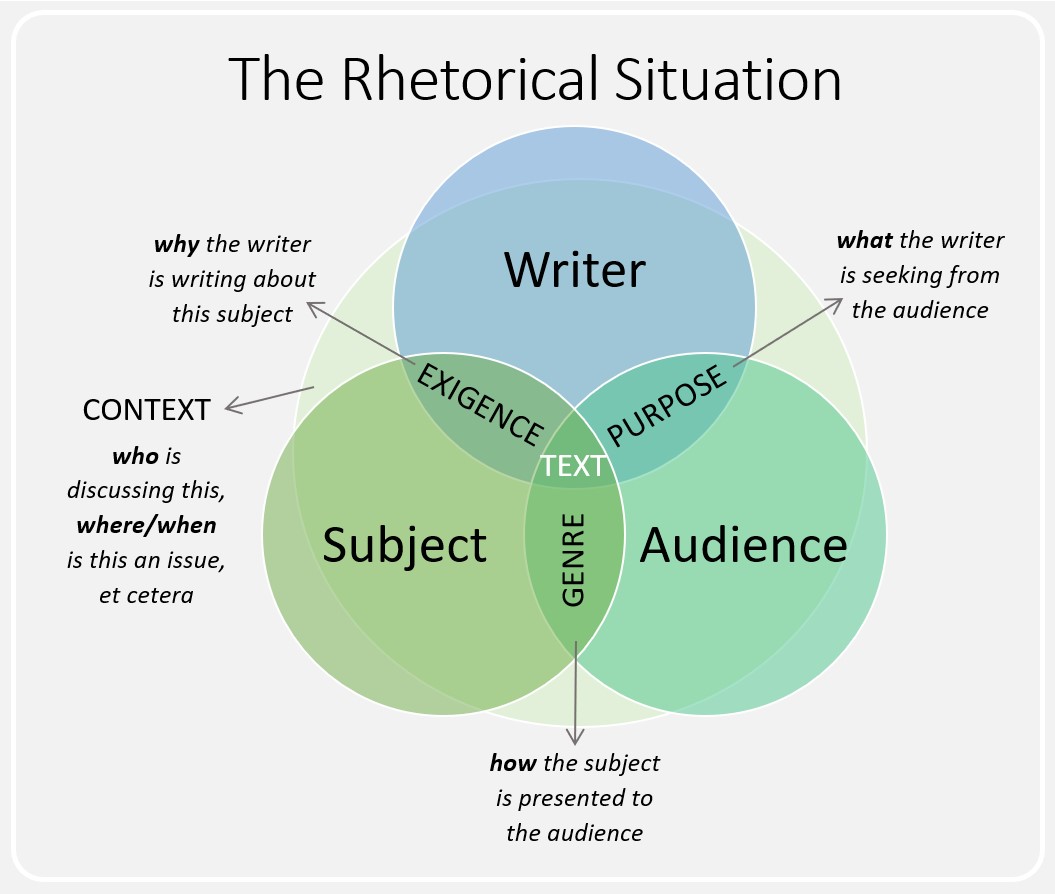
The term “rhetorical situation” refers to the circumstances that bring texts into existence. The concept emphasizes that writing is a social activity, produced by people in particular situations for particular goals. It helps individuals understand that, because writing is highly situated and responds to specific human needs in a particular time and place, texts should be produced and interpreted with these needs and contexts in mind.
As a writer, thinking carefully about the situations in which you find yourself writing can lead you to produce more meaningful texts that are appropriate for the situation and responsive to others’ needs, values, and expectations. This is true whether writing a workplace e-mail or completing a college writing assignment. As a reader, considering the rhetorical situation can help you develop a more detailed understanding of others and their texts. In short, the rhetorical situation can help writers and readers think through and determine why texts exist, what they aim to do, and how they do it in particular situations.
Keith Grant-Davie identifies four “constituents” of rhetorical situations, which can “interlace” with each other, which means they are connected; these include exigence, rhetor (writer or speaker), audience, and constraints (277). Recall that you can think of discourse as language in action or communication.
“Exigence—The Matter and Motivation of the Discourse.” Grant-Davie presents three questions for readers and writers to analyze a rhetorical situation for exigence:
1) “What is the discourse about?” “What fundamental issues are represented by the topic of the discourse?” “What values are at stake?” “What questions need to be resolved by this discourse?” (267). These questions help readers and writers identify what the discourse is about by not only “identifying the subject matter or topic at the most obvious level, but also determining issues that underlie it. . .” (Grant-Davie 268).
2) “Why is the discourse needed?” This question helps readers and writers consider both the cause of the discourse and its value (268). What prompted the discourse and why “now”? Why does the discourse matter?
3) “What is the discourse trying to accomplish?” “What are the goals of the discourse?” “How is the audience supposed to react to the discourse?” These questions can reveal the purpose and agenda of a writer or speaker—their objectives—which may or may not all be stated explicitly (Grant-Davie 269).
“Rhetor(s)—Those People, Real or Imagined, Responsible for the Discourse and Its Authorial Voice.” Rhetor is the term for the writer or speaker of the discourse. “Who is the rhetor?” is a simple question to ask in order to consider this element of the rhetorical situation for a discourse; however, rhetors play various—even multiple—roles in different situations. For example, a discourse may be composed in collaboration with multiple rhetors or sponsored by an agency or corporation. Even a solo author may not be representing only their interests but those of a group or community. Furthermore, a rhetor may have an identity—who they are—that doesn’t change, but their ethos—how they sound or come across (their “character”)—may be different in various rhetorical situations due to exigence as well as audience (Grant-Davie 269-70). Therefore, when considering a rhetorical situation for a discourse, readers and writers should take into account the rhetor’s experiences, values, and needs—whether the rhetor is a person, group of people, or an organization.
“Audience—Those People, Real or Imagined, with Whom Rhetors Negotiate through Discourse to Achieve the Rhetorical Objectives.” Readers and writers also have a lot to consider when thinking about the audience of a discourse. According to Grant-Davie, “A discourse may have primary and secondary audiences, audiences that are present and those that have yet to form, audiences that act collaboratively or as individuals, audiences about whom the rhetor knows little, or audiences that exist only in the rhetor’s mind” (270). Given these variations one way to approach audience is to consider how a discourse “defines and creates contexts for readers” (Park qtd. in Grant-Davie 271). Readers can actually play various roles while reading a discourse: “These roles are negotiated with the rhetor through the discourse, and they may change during the process of reading” (Grant-Davie 271). This means any act of reading a discourse is its own rhetorical situation. Readers and writers should realize when considering the audience of a rhetorical situation that the meaning of the discourse is negotiated; it’s not fixed or absolute but rather dynamic and changing.
“Constraints—Factors in the Situation’s Context That May Affect the Achievement of the Rhetorical Objectives.” Constraints can be thought of as anything—other than the rhetor or audience—that has any kind of effect on the discourse; they may be positive or negative and either “help or hinder the discourse” (Grant-Davie 273). Grant-Davie defines constraints as “all factors in the situation, aside from the rhetor and the audience, that may lead the audience to be either more or less sympathetic to the discourse, and that may therefore influence the rhetor’s response to the situation” (273). Writers and readers should consider the context of a discourse, for example, which may affect it directly or indirectly. This context may include social, cultural, geographic, historical, and political factors.
TRY THIS to understand the concept of rhetorical situation. View this speech, which is Apple co-founder Steve Jobs’ commencement address to the Stanford University 2005 graduating class, and then analyze its rhetorical situation using the rhetorical elements from above. Which of the rhetorical elements do you find most interesting when it comes to this discourse (or the text that is this speech)? Why? Bonus: What discourse community owns this speech? What is the ideology—the way of viewing the world—presented in the speech? Do you subscribe to—agree with—this ideology? How did your answer to that question affect your reading, or view, of this speech?