Introduction to Knowledge Domains of Writing
Do you remember from the introductory chapter the concept of transfer? It’s the idea that in this composition course you will acquire some new knowledge and skills that you can transfer—take with you and apply—to other contexts for writing in other classes and beyond, such as in the workplace. Yet, you also probably remember from the introductory chapter that transfer isn’t easy or automatic and there’s no such thing as writing in general—“good” writing is always specific to particular contexts and situations. So, then, exactly what will you learn in this composition course that will transfer?
Recent pedagogies, or teaching methods, in composition studies identify “key terms” (Yancey et al.) and “threshold concepts” (Adler-Kassner and Wardle) about writing, which are ideas that you need to understand—that you really have to “get”—in order to do well. According to Anne Beaufort in her book College Writing and Beyond, in order to begin the lifelong task of becoming a more expert writer, students need to study and apply the following five knowledge domains of writing: discourse community, subject matter, genre, rhetoric, and writing process. What this means is that while there is no such thing as learning to write in general, you can learn what Beaufort calls the “mental schema” of these five knowledge domains for writing, and you can apply and continue to acquire such knowledge in the various writing situations you encounter throughout your life in any context (Beaufort 17).
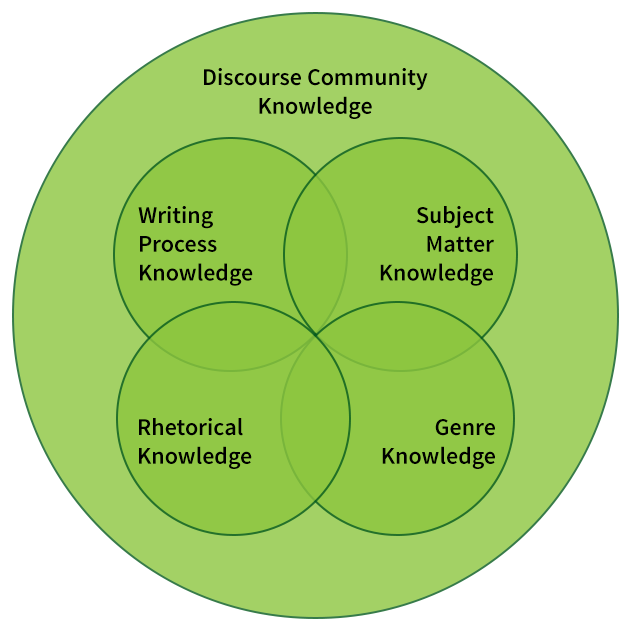
TRY THIS to understand five knowledge domains for writing. This graphic illustrates Beaufort’s five knowledge domains of writing (19). What do you notice about it—how does the graphic depict relationships among them? Which is the largest circle? Why are the other four inside of it—what do you think that means? What do you notice about the four smaller circles—what do you think that means?
As a writer, why should you care about knowledge domains for writing? Beaufort explains, “As an engineer must understand certain laws of physics, chemical properties of materials, etc. to create the desired product, so too, the writer must engage a considerable body of writing knowledge in acts of composing” (18).
In order to understand and apply these knowledge domains to your writing, you will need to learn to study both written texts and writing itself, a skill you will find useful as a writer not only in college but your entire literate life. This challenges you to look at written texts differently from how you are probably used to “because of the ways that text and writing are typically discussed in schools and in the popular culture” (Bazerman and Prior 6).
For example, you may think that only certain texts are worthy of study like published journalism or literature; however, here we consider all texts including street signs, social media posts, and resumes (7). Also, you may think of writing as sitting alone getting words on a page and that nothing more is involved; however, here when it comes to writing “we’re really looking at a complex literate activity that includes reading and writing, feeling and thinking, speaking and listening, observing and acting” (7). Lastly, our natural attitude toward texts and writing is to seek only meaning, often through critique and interpretation (7-8). However, here we focus on “what texts do and how texts mean rather than what they mean” (3): “To understand writing, we need to explore the practices that people engage in to produce texts as well as the ways that writing practices gain their meanings and function as dynamic elements of specific cultural settings” (2).
As Bazerman and Prior illustrate, we can learn so much more from texts and writing beyond meaning that we can apply to our own practices as writers by examining, for example, “how [do] people actually go about producing texts” and “how [do] social systems of activity depend on and promote particular kinds of texts” (3)? Considering these questions and more is our analytical purpose in this chapter to study what texts do and how they mean.
Let’s get started on your lifelong journey of becoming a more expert, studied writer by examining five knowledge domains for writing.